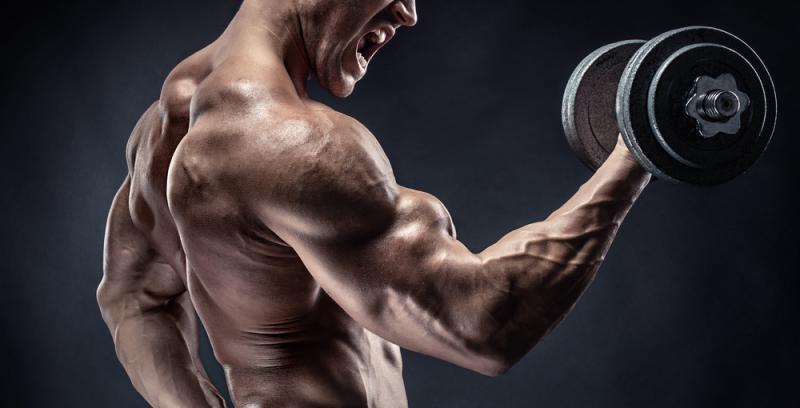
Let’s get right to it: You’re looking for the best workout for bigger arms, and you’ve come to the right place. But before you screenshot the exercises below, grab your gym bag, and head out to the weight room, there are a few things you should know.
If building bigger arms were as simple as banging out biceps curls, a lot more guys would have them. But what we know from peer-reviewed, published scientific research is that the best way to build muscle is not so much about the particular exercises you do as it is about the way you do them.
“The key is not the exercise selection,” Luke Carlson, founder and CEO of Discover Strength, says. “Almost every guy is doing the right exercises. They’re just not doing them in a way that stimulates muscle growth.”
Speaking of exercise selection, it’s not all about the biceps, either. “A lot of people make the mistake of just focusing a little bit too much on the biceps. The triceps is actually the bulk—about two thirds—of the arm,” says Antony Brown, personal training leader at Life Time in Lake Zurich, Illinois.
“Most times, when guys say they want bigger arms, they’re thinking about their biceps,” Carlson says. “If you want to have the look of more size on your arms, which is really what we’re talking about, training your triceps contributes a lot to that look.”
Read on for more exercise advice from Carlson and Brown, along with a quick refresher on the key muscle-building strategies to make sure your gains stick when you leave the gym.
Train to (or near) failure
The research is very clear that mechanical tension is a powerful driver of muscle growth. Mechanical tension refers to the involuntary slowing down of your reps that occurs as your muscles fatigue. It is not the same thing as time under tension, which typically involves consciously slowing the speed of your reps overall (and, FYI, hasn’t been shown to influence muscle growth).
As you might have guessed, maximizing mechanical tension means training to failure, or at least to within one or two reps of it. But the good news is that weight and reps have no bearing on results—meaning, you’ll gain just as much by reaching failure with five heavy reps as you would with 20 light ones. “You have some autonomy here,” says Carlson. “If you like to do heavy weights and do four or five reps, that’s fine. If you like to use a lighter weight and do more repetitions, that’s also fine. The science is clear: It is the exact same.”
Lower, slower
Studies have shown us that the eccentric, or lowering, portion of a rep is where the real magic happens. Yet most guys still delegate this phase of the rep to gravity. “No one does it, because people are just unaware,” Carlson says. “How do we learn how to lift weights? We just look at the guy in the gym that’s got slightly bigger biceps than us, and this is what he’s doing. He lifts it and lets it drop. Largely, exercisers don’t read scientific research.”
To maximize the eccentric side of your reps, Carlson suggests “lifting for about two seconds, lowering for four seconds, and also considering going to the point of failure and then doing some eccentric work after that.” With the help of a gym buddy, you can even isolate the eccentric phase entirely. “If we really want to stimulate size in the biceps and triceps, we would do a lot of eccentric-accentuated or eccentric-only training,” says Carlson. “Having a training partner lift the weight for you, and you lowering it for 10 seconds, is about as valuable as it gets.”
Feel the stretch
When we do exercises like biceps curls and triceps pushdowns, we tend to emphasize the peak contraction of the rep. However, the lengthened position might be just as valuable, if not more so. “One mistake that a lot of people make is they’ll focus on that squeeze at the top of the rep, but not necessarily lengthen the whole muscle at the bottom,” Brown says. “A lot of the research nowadays is showing that we can stimulate more muscle growth by working in that longer range of motion.”
“If you think about standing and doing a biceps curl, the top half of the rep is probably less valuable for developing the overall size of your biceps than the bottom half of the rep,” says Carlson. “So just make sure you’re not neglecting what’s called the lengthened position, where the muscle has a longer actual length.” This applies to the triceps, too. Take the skull crusher, for example. “When your elbow is locked out, that first half is the less important portion,” says Carlson. “As you get more into a stretch, and the weight comes closer to your upper back, that’s the more valuable part from a hypertrophy standpoint.”
Keep pushing
Probably one of the most enduring and widely established principles in weight lifting, progressive overload means routinely and consistently demanding more from your muscles. That could mean putting more weight on the bar than last week, or even just eking out an extra rep. (Note: Bolting on an extra set does not count as progressive overload.)
“If doing 12 reps with 20 pounds is comfortable for me, and I continue doing that forever, I’m probably not going to get the best results. My body’s used to it. It has no reason to adapt,” says Brown. “We always want to have that progressive overload, whether you’re increasing the weight by five pounds, or you’re adding a couple of reps each workout, that’s essentially going to give you the demand that’s going to force your muscles to grow.”
Six trainer-approved exercises for building bigger arms
Here, Carlson and Brown list their top exercises to get you armed: a combination of six isolation and functional movements to absolutely overload your biceps and triceps.
To save time, Brown recommends performing the six exercises below as three supersets—that is, in pairs, completing all sets in one pair before moving on to the next. “You’re also going to get a bigger pump that way,” he says, “and they’re not going to take away from each other, because they’re what are called antagonistic muscles. They work in opposition to each other.”
Aim to complete this workout one to two times per week, depending on what your other workouts look like. “The other thing to think about is if this overlaps with your back and your chest workouts,” Brown says. “If you’re doing a chest workout, or even a shoulder workout, you’re likely going to have a good amount of pressing, which is going to involve the triceps. And with back, you’re going to be doing a good amount of pulling, which is going to get the biceps. So, for most people, I would say probably once a week is good.”
To do the exercises below as supersets, perform one set of the exercise marked “1A,” followed by one set of the exercise marked “1B.” Continue alternating between those exercises until all the prescribed sets are complete. Then move on to the exercises marked “2A” and “2B,” and so on.
1A. Triceps Pushdown
Sets: 1–2
Reps: 5–8
- Head over to the cable station and attach the rope handle to one of the pulleys. Adjust the height of the pulley so that the ends of the rope attachment are at about shoulder height.
- Square up to the cable and grab one end of the rope attachment in each hand. This is your starting position.
- With your core braced and elbows glued to your sides, pull the weight down slowly, allowing your hands to drift to your sides as you move through your full range of motion.
- At the top of the rep, squeeze your triceps as you lock out your arms, and then slowly reverse the movement to return to the starting position. That’s one rep.
1B. Preacher Curl
Sets: 1–2
Reps: 5–8
- Walk over to a preacher curl bench. (You could also use the preacher curl machine.)
- If you’re using the bench, grab an EZ curl bar as well, and add some plates.
- Sit on the bench and set your upper arms on the elbow pads, arms extended. Grab the barbell with both hands and lift it off the hooks to create tension in your biceps. This is your starting position.
- From here, curl the bar all the way up, moving through your entire range of motion. Pause for a count at the top of the rep, and then slowly reverse the curl to return to your starting position. That’s one rep.
2A. EZ Bar Skull Crusher
Sets: 1–2
Reps: 5–8
- Grab an EZ bar—that shortened barbell with the zigzag handles—and throw some plates on there. Then find yourself a freestanding bench (with no rack behind your head).
- Lie flat on the bench and hold the weight above you, as if you were about to do a bench press. This is your starting position.
- Instead of lowering the weight to your chest, keep your upper arms (from your shoulder to elbow) perfectly still as you bend at the elbows to lower the bar behind your head.
- Pause for a count, and then extend your elbows to drive the weight back up to the starting position. That’s one rep.
2B. Hammer curl
Sets: 1–2
Reps: 5–8
- Either standing or seated, grab a dumbbell in each hand and let your arms hang almost completely straight at your sides, palms facing one another.
- Keeping your upper arms locked in place, bend at the elbows to slowly curl the weights up, maintaining a neutral grip throughout the movement.
- Pause for a second once the dumbbells arrive at the top of the rep, near shoulder level with an inch or two to spare.
- Still keeping your upper arms in line with your torso, slowly reverse the movement to return the weights to the starting position. That’s one rep.
3A. Dip
Sets: 1–2
Reps: 5–8
- Find a pair of dip bars. They can be parallel or angled—whichever is more comfortable.
- Grasp one handle in each hand, and then extend your arms to suspend your body above the bars, crossing your knees behind you. This is your starting position.
- Keeping your elbows in tight, slowly lower your body until your upper arms drop just below parallel with the floor. Pause here for a count, and then press yourself back up to the starting position. That’s one rep.
- To add weight, you can hold a dumbbell between your knees, attach plates to a weight belt, or wear a weighted vest.
3B. Chin-Up
Sets: 1–2
Reps: 5–8
- Stand below a pull-up bar. If you can reach the bar with a small hop, that’s a good height. If it’s any higher, set up a small step or box under the bar so you can safely step up and down between sets.
- Grab the bar with a supinated grip, hands about shoulder width apart. Your arms should be roughly parallel with one another.
- From a dead hang position, knees slightly bent with ankles crossed behind you, pull yourself up until your chin is just over the bar.
- Hold this position for one second. Then slowly, with control, lower yourself back to a dead hang. That’s one rep.